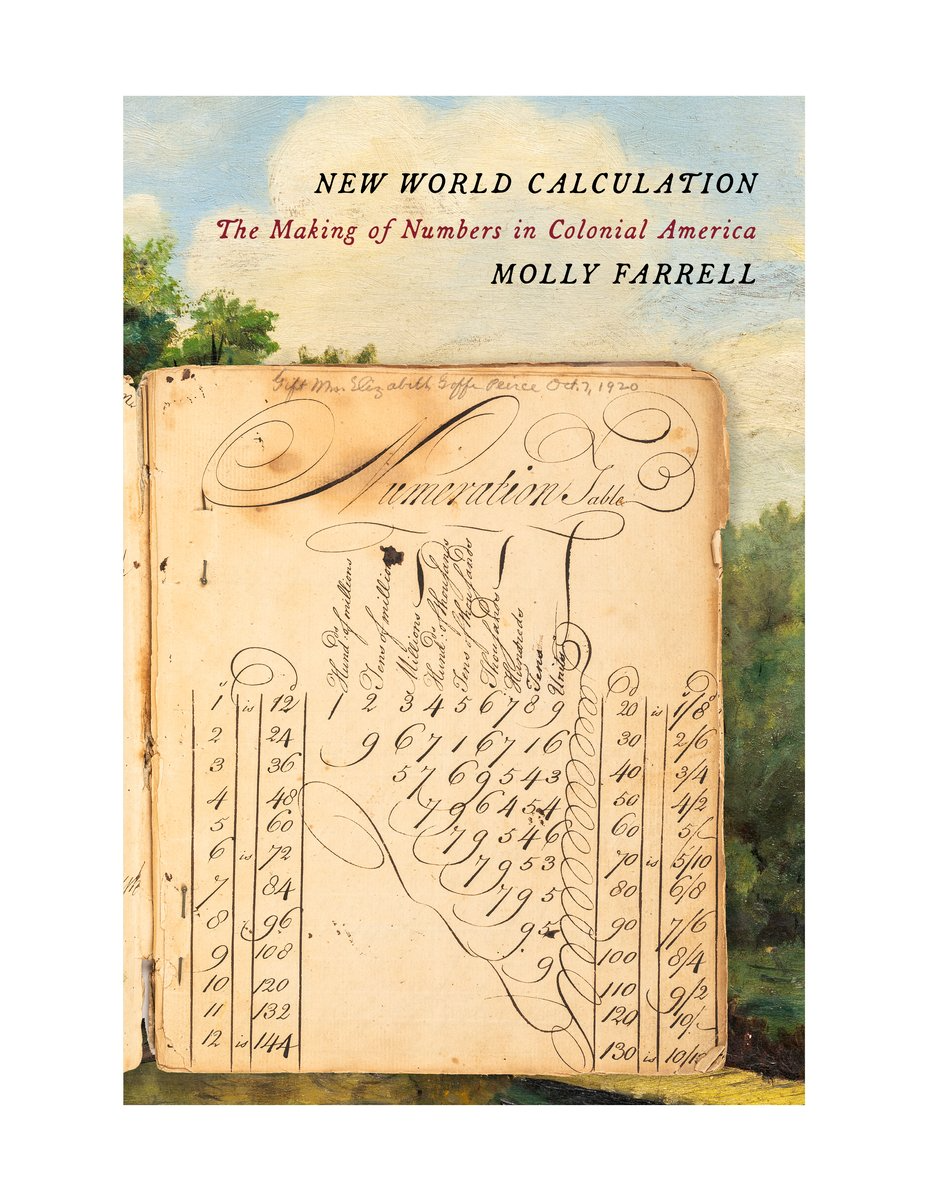
New World Calculation:
The Making of Numbers in Colonial America
Published August 25, 2026
Preorder now:
"Farrell offers a timely, elegant, and compelling argument about the ways in which colonialism shaped numerical knowledge, and vice versa, in the early Americas, doing for numeracy what scholars have done for what she slyly calls 'alphabeticity.'"—Patricia Crain, New York University
"In an imaginative rethinking of arithmetical knowledge in early America, Farrell examines acts of counting and calculating as sites of meaning, struggle, and expression. An intellectually adventurous encounter with white, Black, and indigenous peoples speaking the language of numbers."—Tamara Plakins Thornton, SUNY, Buffalo
"New World Calculation recasts the history of numbers as a distinctly human, deeply political story. Cracking open early account ledgers, arithmetic primers, and ciphering workbooks, Farrell uncovers intertwined histories of knowledge, race, and technology—as wielded from both above and below—that undergird modern data culture. In this deeply researched book, Farrell brings the study of numeracy into the field of vision of histories of settler colonialism and racial capitalism. Strikingly original and eminently readable, this book places the past in conversation with today's algorithmic world in brilliant and generative ways."—Elizabeth Maddock Dillon, Northeastern University
Molly Farrell tells the story of colonial America as a testing ground for new ways of conceptualizing numbers, uncovering overlooked forms of numerical thinking to argue that colonialism and the rise of racial capitalism incited a struggle about what exactly a number is and what it can do.
When English settlers began colonizing Indigenous lands, they confronted groups of people with very different beliefs about numbers. Meanwhile, Atlantic colonialism required tremendous accounting work, especially to support the trade in enslaved Africans. Numeracy, then, seems to be deeply complicit with the colonial project. Farrell, however, follows the circulation of arithmetic primers, cipher books, and other material traces to show how everyday people repurposed numeracy to serve their own ends—ranging from making a living as a fugitive from enslavement to measuring medicine for at-home abortion.
Drawing on book history and Black feminist science and technology studies, New World Calculation argues that we need to restore the math book into its social space in order to disentangle the relationship between quantification and oppression in America's cultural history.
Counting Bodies:
Population in Colonial American Writing
Oxford University Press, 2016
"Farrell's Counting Bodies examines ways of counting people in the British Colonial Atlantic using forms of literature such as poetry, captivity narratives and travel writing and mortality bills. Farrell makes the claim that such texts, disparate as they may be, nonetheless offer insight into what she terms 'human accounting' in the seventeenth and eighteenth century colonial context." -- Philippa Chun, British Society for Literature and Science
"I was continually excited by this book, and was especially struck by the way that Farrell's focus on the literary representation of population, and particularly on bodies that are difficult to count, might open up new possibilities for thinking about the complexity and variability of colonial American ideas of community. I'm persuaded, for example, that her book can help us think about colonial understandings of disability, another form of human categorization that was just beginning to emerge during this period. ... Just as important, however, is her careful attention to how writers in early America obstructed, disallowed, and resisted this kind of counting. Farrell's book is worth thinking with, and I'm eager to see how her methods and conclusions might further expand and enliven our understanding of what it meant to count and be counted in colonial communities." --Nicholas Junkerman, Common Place
"Counting Bodies takes a very stimulating approach to its subject matter, and as an alternative route to understanding the emergence of population ideas it is to be welcomed." --Robert J. Mayhew, Journal of Historical Geography
"If we take the counting of bodies today as an ordinary act of the state, Farrell invites us to consider a time when counting bodies was unusual and, further, takes us deep into the historical quandaries surrounding the counting of bodies. What is a countable body? Where does one body stop and another begin? In this book, Farrell brilliantly sounds the literary pre-history of the concept of population on colonial ground, illuminating the work that gender and race perform in the history of settler colonialism and European imperial expansion in early America." --Elizabeth Dillon, author of New World Drama: The Performative Commons in the Atlantic World, 1649-1849
"By providing the reader with insight into the history of biopolitics before 'biopolitics' became the chief method of government, Farrell accomplishes something quite remarkable. Still more to her credit, she adds to the growing archive of early American texts by exploring the aesthetic dimension of literature, which doubled the perspective of these same procedures to expose the blindnesses induced by numerical representations of human life." --Leonard Tennenhouse, author of Power on Display: The Politics of Shakespeare's Genres
"This is a marvellously rich reading of the conceptual logics associated with counting peoples. Treating colonialism, mortality, race and constitutionalism, Counting Bodies offers a compelling poetics of the enumerative imagination. It powerfully highlights the political implications of counting people--dead, alive or unborn--populating the margins of systems of race, gender and religion." --Peter Thompson, co-editor of State and Citizen: British America and the Early United States
Quantifiable citizenship in the form of birth certificates, census forms, and immigration quotas is so ubiquitous that today it appears ahistorical. Yet before the modern colonial era, there was neither a word for "population" in the sense of numbers of people, nor agreement that monarchs should count their subjects. Much of the work of naturalizing the view that people can be represented as populations took place far outside government institutions and philosophical treatises. It occurred instead in the work of colonial writers who found in the act of counting a way to imagine fixed boundaries between intermingling groups.
Counting Bodies explores the imaginative, personal, and narrative writings that performed the cultural work of normalizing the enumeration of bodies. By repositioning and unearthing a literary pre-history of population science, the book shows that representing individuals as numbers was a central element of colonial projects. Early colonial writings that describe routine and even intimate interactions offer a window into the way people wove the quantifiable forms of subjectivity made available by population counts into everyday life. Whether trying to make sense of plantation slavery, frontier warfare, rapid migration, or global commerce, writers framed questions about human relationships across different cultures and generations in terms of population.
ESSAYS